GETTING STARTED
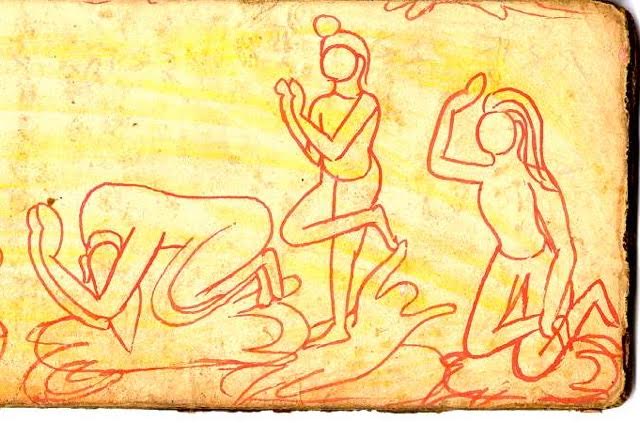
Session 1. The Dance of NamaskāraHow the Pāśupata Lineage transformed Yoga into a Life-Affirming PracticeWithin a century or so of the Yogasūtra's composition, an avant-guarde religious group rose to the forefront of radical Indian radical, Known as the Pāsupatas, these quasi-ascetics lived on the margins of society where they worshiped Rudra ('Howler'), who the archaic namesake of Shiva. Yet ironically it was the Pāsupatas who first took Yoga in a new direction by integrating the framework for practice recently established in Yogasūtra, with movement practices adopted from the Nātya-śāstra, the ancient 'Treatise on Dance.' In this session, we will learn how the Pāśupata Yogīs transformed 'Namaskara' from a simple daily ritual of reciting Gāyatrī Mantras to the Sun into the dynamic movement practice known throughout the modern world.Source Passages: the Pāśupata Sūtra and its Two Commentaries (ca. 3rd - 6th centuries AD) Session 2.- Maṇḍala Vinyāsa -The Place of daily Namaskāra Practice in Early Tantric YogaHaving encircled one's mandala from within, the yogin is to perform the practice of sūrya namaskara prostration, culminating with a seated position, facing east..."- excerpt from the Brahma Purāṇa, ca. 10th century"One circles the Axis of the maṇḍala for the ritual of bowing to the directions. One should first recite a verse and sprinkle the water consecrated with mantras from a conch shell.Next one should lower to the earth through the postures natural to a dog, prostrating in the shape of a staff (daṇḍa-vat); Then one arises from the earth in an ecstatic state after making an offering to the mūrti (symbol of the divine)."- Nāradīya Tantra, ca. 12th century Session 3.-Pradakṣiṇa -Preparatory Rites to Sūrya Namaskāra in early Tantric Yoga Practice -"You are every [inflection of my] voice [as I recite this] devotional hymn throughout [my] circumambulation [around the Axis of the Maṇḍala]. As I engage the sequential activity of this Ritual, it is You, O Śambhu, who perform each and every act, and its unbroken continuity; for I experience this devotional ritual entirely within You. O Śambhu ...You are My Self."- Tantric Pradakṣiṇa Namaskāra Verse, cited by Aghoraśiva, 12th century Session 4.Āvāhana ('Summoning' the Divine)The Evolution of Sūrya Namaskāra into a Daily Yoga Ritual for Liberation'OṂ! KHAṂ! I bow to He (Shiva) who embodies the Sun and to She (Shakti) who emanates as His Firery rays pervading in all directions throughout the Sky! I bow to Shiva, whose manifest form is that of the Sun, embodied in the solar seed mantras - oṃ hrāṃ hrīṃ hrūṃ hraiṃ hrauṃ and hraḥ!"-Cintya Tantra (ca. 6th-7th centuries) Session 5.- Daṇḍa Namaskāra -The Evolution of Sūrya Namaskāra into a Daily Yoga Ritual for Liberation* Middle period, 8th - 11th Centuries; preview of part II *"... After going outside to worship of the Goddess, the Yogī performs a gradual prostration sequence towards the earth by engaging a group of staff-related (Daṇḍavat) postures.... one is to perform prostration (praṇāma) towards the earth bending (his body) in a series of (half-) maṇḍala shapes related to the shapes the bow (of an archer) can make. O Shiva, the prostration series in which one engages an arrangement of these Daṇḍavat poses includes the pose of four sections of the body ('Caturaṅga Praṇāma')."- from the Paraśurāma-kalpa-Sūtra (un-published, composed in Kashmir ca. 1600 A.D.), translated on 12/15/2015 by C. Tompkins